MeterRec released

Icon for MeterRecI’ve just released my first purchasable app on the Android market.

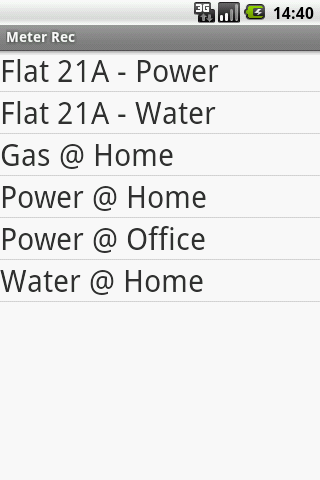
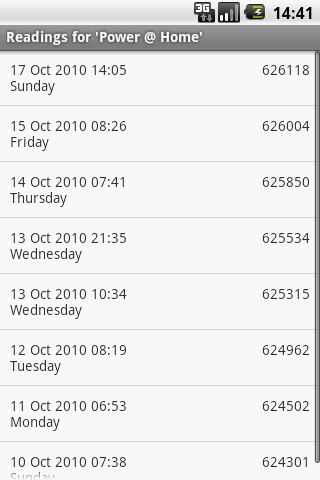
The app is called MeterRec and it allows you to easily record readings for gas, water and power or other similar meters.

These readings can then be exported as a .csv file for manipulation and graphing in applications such as Excel.

This app is ideal for property managers, flat mates or those (like me) who just want to keep tabs on what they are using.

If you have an Android phone then point your barcode scanner at the QR code above, to get a link to the app in the market. For those of you without an Android device, here are a couple of screenshots:

If Star Trek’s computers were real…

Posted by a friend of mine on Facebook… I LMAO:

To be more realistic, Star Trek interactions with the computer should have gone more like this:

“Computer, hail the Klingons.”

“What was that?”

“Hail the Klingons!”

“To help me understand you better, please tell me what you just said…..

1) Ale to Vogons

2) Hail on Vulcan

3) Bale for Klingons”

“None of the above!”

“Initiating death from above.”

“No, stop!”

“Coming to full stop.”

Auckland bus stops in Google Earth

Since Jonah asked for it, I have generated a KML file of the Auckland bus stop data. If you have Google Earth installed then click on this link to see the stops overlaid on an actual map: http://www.rabidgremlin.com/viz/auckland_bus_stops_kml/auckland_bus_stops.kmz

If you hover over a red dot you will get the stop’s number. Interestingly if you zoom in enough, you will see that Google already has all the stops loaded and if you click on a little bus icon under a red dot, you will get the route info for that stop.

Have fun.

Playlist dumper for iTunes

I’ve been meaning to write this bit of software for a while now, its a simple app that dumps out all your playlists in iTunes into .m3u playlist files.

I use it to generate playlists that my HTPC (running Boxee) can play.

It’s a .NET app. You can download it here: PlaylistDumper_v101.zip

If the “dump folder” is the root of your music library then the .m3u file will contain relative paths which is useful for playing across network shares.

Fun with Auckland bus data

A couple of days ago I discovered that Auckland Regional Transport Authority (ARTA) make all of their bus schedule data available for download from the maxx.co.nz site. The data is in the Google Transit Feed format, which means that it consists of a bunch of comma separated value text files, describing things like stops, routes, trips and calendars.

I decided to see what I could do with this data. Below is my first attempt. It is a “density” map of all the bus stops in Auckland.

'Density' map of Auckland bus stops

Click here for a hi-res version that allows you to pan and zoom.

The initial version of the map only took about 30 minutes to create but I have spent a few hours tinkering with it since then.

Quick guide

Here is quick guide to the process if you want to try something like this yourself:

  1. I extracted stops.txt from the data set
  2. I then gpsvisualizer.com to plot out the stops as data points on map. I got it to output a 4096 pixel wide .svg file
  3. Next I used Inkscape to edit the .svg file, adding the text & zoomed area and exporting the result as a  .png file.
  4. Lastly I used the Google Maps Image Cutter to generate the pannable and zoomable version. The Google Maps Image Cutter is a pretty neat tool. It takes any big image, chops it into different resolution tiles and then spits out some html which uses the Google Maps API to view your chopped up image.

Next steps

If I get some more time I will try create some more visualizations. I’m thinking  it would be interesting to merge the bus stop density data with some population data. Also an animation showing 24hrs of bus movement compressed into a couple of minutes would be pretty nice too.

The Amen Break

Came across this fascinating clip about the “Amen Break”, a 5 second sample taken from a 1960 b-side recording by a funk and soul bank. Amazingly this loop became the basis for drum-and-bass and jungle music. Not to mention that it has been used on numerous hip-tracks too.

Watch the video below and check out the Wikipedia page for more info

YouTube Preview Image

BTW if you ever played with MOD trackers in the 90's then check out Sony's free ACID Xpress and relive those glory days :)

Jumbler, my first flash game

Over the weekend I published my first flash game, it’s called Jumbler. There is not too much to the game, to be honest. It was really more the result of me tinkering with the Flixel game framework to see what it could do; rather then my idea of a “blow your mind, addictive game”.

I’m must say that I’m pretty impressed with Flixel. Jumbler took less then 10 hours to put together and the bulk of the time was spent on the theme and graphics (such as they are). The initial game code (with box only graphics) took only about 3 hours.

The other cool thing was that this was built with entirely free tools and assets:

  • Flixel – is a really great AS3 game framework. It does a fantastic job of turning flash into a game engine and letting you focus on writing a game, not on fighting with Flash.
  • Flex SDK – The flash compiler and tools given away by Adobe.
  • Flashdevelop – An open source Flash IDE. Syntax completion is a dream.
  • Inkscape – An open source vector editor kinda of like Illustrator. It uses SVG as its native format and has excellent .png export support. All the graphics in Jumbler are drawn with Inkscape which made it really easy to resize, edit and evolve them on the fly.
  • Flash Kit – Excellent resource for free sound effects.
  • dafont.com – Excellent resource for free fonts. This is where I found the Boingo font that I used to drive the look of jumbler.

If you are interested in getting started with Flixel, then check out these links. The first is a basic “Hello World” tutorial, which shows you how to get your environment set-up and write a simple Flixel app. The second shows you all the key concepts you need to understand to build a game in Flixel, by creating a simple Defender style game.

I’m thinking of porting my half-finished “nac” game over to Flixel and integrating Box2D for the physics. It should be interesting.

The viral spread of my privacy check app for Facebook

Last week, interested by the noise on the interwebs about Facebook and privacy, I put together a small app using Facebook’s API that shows exactly what information you are giving away to Facebook enabled sites.

Thinking that others might be interested, I tweeted a link  and shared the app with my friends in Facebook. Now I don’t have a large social network about 220 followers on Twitter and 125 friends on Facebook, but the “like” counter for the app quickly started to grow first 10, then 20 and after a day close to 100!

A couple of days later, somewhat ashamed by how ugly the app looked, I did some work to pretty it up and I added a “privacy score”. I then retweeted the link, did a Facebook status update and went to bed.

The next morning (17 May), I was very surprised to see that I now had 200 “likes” and over 1500 page views. Over the next few days things started to  grow rapidly. I watched anxiously, concerned that my tiny little web server was going to explode…

I also started to wonder how people were actually out finding the the app. Here is what I can surmise from looking at my site logs and analytics.

Page hits and visitors

First off here are the graphs showing the page hits (dark blue) and unique visits (light blue)  per day:
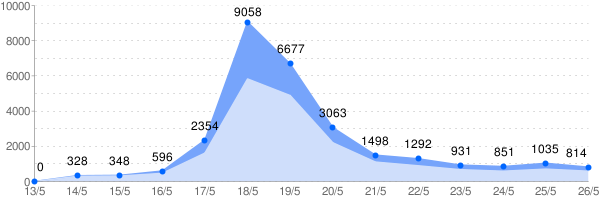
As you can see the app was at peak usage on the 18th May. To date the app has had 1936 “likes” and 28845 page views.

Where did all the traffic come from?

The bulk of the traffic (64.55%) came from referring sites, 34.05% came from direct traffic and a measly 1.4% of the traffic was from search engines.
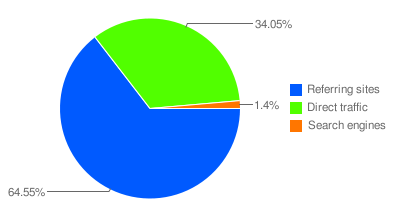
Of course a large percentage of the referring traffic was from Facebook, as my app allowed people to post their “privacy score” for all their friends to see. The post included a handy link back to my app so that others could then easily check their score.

A total of 11.8% of the total visitors to the app came from Facebook. The other referring traffic was from the large number of blogs and websites that posted articles about the Facbook Privacy issue with links back to my app. In fact there were over 100 sites that did link back to the app which is pretty staggering. See the end of this post for a list of some of them.

The direct traffic figure of 34.05% is interesting as it is highly unlikely that anyone was typing the URL to the app (http://www.rabidgremlin.com/fbprivacy) directly into their browser. I can only guess that that these visits must have come from people clicking links in various (non-browser based) twitter, RSS feed and (perhaps) mail clients.

Looking at the data I would suggest that over 45% of the total traffic could be attributed to social networking ! (the 11.8% from Facebook and the 34.05% direct traffic).

Riding the hype curve

I suspect that the primary reason that the app became so popular so quickly was it appeared right when there was the most Internet buzz about Facebook privacy.You can clearly see the strong build up and the equally sharp drop off in traffic as the Internet became enamoured with some other topic.

Did I WIN?

Now if my app was a commercial product then I would say NO. Around about the same time as my app went live so did several others such as: youropenbook.org, reclaimprivacy.org and Saveface.

I would say that reclaimprivacy.org would be a direct “competitor”. If you take a look at their site they have over  238000 shares and over $3000 in donations. So around 12100% more shares/likes and roughly 60000% more in donations!  BTW I must give a shout-out to Brian for his donation (and yes it is enough to buy a beer in New Zealand, thanks).

Clearly reclaimprivacy.org would be destroying me if we were competing businesses :)

So why did they do so much better?

I don’t believe that it is the “product”, several sites have mentioned that my app provides the most in-depth information.

I could see that perhaps it is because their app looks better but no one mentioned that my app was ugly or unusable.

I suspect that the answer is that of trust, reclaimprivacy.org has a nice domain name, the author released the source code and perhaps more importantly the author (Matt Pizzimenti) is readily identifiable. On the other hand, rabidgremlin.com sounds a bit suspect and I go out of my way to keep my identity secret (not that it would be hard to figure out who I am).

My suspicion is borne out by some of the descriptions of my app, such as this one:

The application is built by rabidgremlin, who doesn’t tell us anything about himself (I’m making an assumption here) and claims New Zealand as his home on his Twitter page. Can you trust the site?

I guess I’ll need to take this into account for future projects :)

Sources of traffic

The following list shows some the sources of traffic to my app:

http://sikkerhed.tdc.dk/publish.php?id=24892

http://youropenbook.org/about.html

http://www.f-secure.com/weblog/archives/00001952.h

http://www.net-security.org/article.php?id=1439

http://www.hwsw.hu/hirek/44627/facebook-adatvedele

http://www.infospyware.com/blog/facebook-privacy-c

http://news.ycombinator.com/item?id=1346003

http://webisztan.blog.hu/2010/05/17/teszteld_hogy_

http://www.simplyzesty.com/facebook/tool-lets-chec

http://themoderatevoice.com/73103/concerned-about-

http://www.guardian.co.uk/technology/blog/2010/may

http://bagtheweb.com/oembed/proxy/IBB2DI

http://www.taringa.net/posts/info/5534654/Facebook

http://37signals.com/svn/posts/2330-diasporas-curs

http://index.hu/tech/2010/05/21/kivonulas_a_facebo

http://www.informacija.rs/Vesti/Privacy-Check-apli

http://news.ycombinator.com/item?id=1354731

http://slo-tech.com/novice/t416348

http://flipthemedia.com/index.php/2010/05/facebook

http://wiredpen.com/2010/05/18/facebook-and-privac

http://www.cnis-mag.com/quand-les-navigateurs-parl

http://www.reddit.com/r/technology/comments/c3jyi/

http://caballe.cat/wp/eina-que-calcula-el-nivell-d

http://www.reddit.com/r/reddit.com/comments/c557m/

http://www.facebook.com/notes/f-secure-labs/facebo

http://www.cnis-mag.com/4456.html

http://www.taringa.net/posts/info/5515348/Facebook

http://taringa.net/posts/info/5534654/Facebook-Pri

http://twitter.com/mikebutcher

http://www.wir-muessen-twittern.de/blog/2010/05/18

http://www.techsupportalert.com/content/probably-b

http://www.matuk.com/forosmatuk/vida-digital/priva

http://livingwithoutfacebook.com/

http://giovannidepaola.nova100.ilsole24ore.com/201

http://blog.f-secure.jp/archives/50403236.html

http://youropenbook.org/about

http://socialbits.net/blog/facebook-and-privacy-to

http://www.lemagit.fr/article/google-france-facebo

http://news.ycombinator.com/item?id=1347982

http://www.websegura.net/2010/05/teste-a-sua-priva

http://www.plurk.com/bikerock

http://www.lemagit.fr/article/google-france-facebo

http://www.softcatala.org/planeta/

http://www.islamicaweb.com/forums/science-technolo

http://vulps.forumotion.com/discussion-f4/oo-er-so

http://twitter.com/theharmonyguy

http://twitter.com/harryadams

http://maketecheasier.com/4-tools-to-unscramble-yo

They’re baaack! Revenge of the blobs

Well they’re back., those supposed slime moulds that have previously turned up on my lawn. This year they seem a bit more widespread. They are just so weird I had to take some more pictures:

For reference they are about 7cm to 15cm in diameter. I still not convinced that they slime moulds as they don’t appear to match any picture of a slime mould that I have found on the web…

New theme is a go

Well, it has been a while since I posted something meaty, I’ve been kinda doing a lot of micro-blogging and tinkering with other things like my Privacy Check for Facebook, so haven’t really had time to sit down and write a decent post.

Of course as soon as I did sit down to write something, I got hideously distracted with the idea of creating a new theme for my blog…

Luckily due to some very handy tools, it did not take nearly as long to finish off my new theme as it could have.

First up Blueprint CSS, this is a fantastic CSS framework. I used it for contactprotocol.org and for my Privacy Check for Facebook app so it was a no brainer to use for the theme. If you are not a hard-core webcoder then this is the easiest way to put together a good looking website that just works.

Next up: jQuery, which, is a fantastic Javascript framework. I’m really getting to grips with it and there is no way I would ever build another site without using a Javascript framework of some kind.

For instance I have a lot of code examples on the blog. These I  format into

 blocks so that they are easier to read. Problem is that they are often very wide and would get cut off with this new theme. A bit of digging around on the web and little bit of Javascript and we have the following; a code block that expands when you hover the mouse over the it. Here is an example (and the actually code):

//this code finds all pre tags and makes them expand on hover
//code has been formatted to be extra wide to demonstrate the effect
$('div.entry').find('pre').wrapInner('').hover(function()
                                               {
                                                 var contentwidth = $(this).contents().width();
                                                 var blockwidth = $(this).width();
                                                 if(contentwidth > blockwidth)
                                                 {
                                                   $(this).animate({ width: '950px'}, 250);
                                                 }
                                               }, function()
                                                  {
                                                  $(this).animate({ width: '640px' }, 250);
                                                  });

I also used Fancybox to create a lightbox effect for images and image galleries. For example try clicking on one of  the images below:

Lastly I used the new Google Font API (that was released this week) to embed the cool font I used for the blog & post titles in a cross browser compatible way. The font is Reenie Beanie by James Grieshaber.

So what do you think? Leave a comment :)